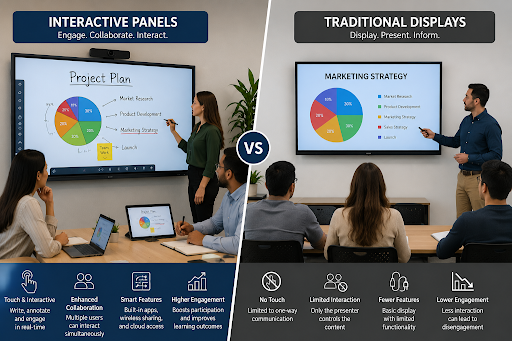

The main benefits of LED screens for business use include enhanced visibility, energy efficiency, durability, and the ability to display dynamic and engaging content that captures customer attention.
I’ve spent years in classrooms. Front of the room. Back of the room. Staff meetings that run long. Lessons that move fast, days that go on forever.
And if there’s one thing I’ve learned, technology either helps… or it gets in the way. There’s rarely a middle ground.
Today’s workplaces and classrooms are evolving quickly. Expectations are higher. Attention spans are shorter. Collaboration is no longer optional.
That’s where the conversation around interactive panels vs traditional displays really starts to matter. Because this isn’t just about screens. It’s about how people think, engage, and learn.
When front-of-room blackboards were the new thing pushed by universities in the 1800’s, teachers rebelled against it. Push back and resistance to using new technology in the classroom is nothing new.
Why Display Technology Matters in Meeting Rooms and Classrooms
A display isn’t just a display in a classroom.
It’s:
- A teaching tool
- A collaboration hub
- A communication platform
In both education and business, the environment shapes behaviour. I saw it firsthand in the classroom. Put a static whiteboard in front of students, and engagement stays flat. Introduce something dynamic even slightly interactive and participation lifts almost immediately.
Meeting rooms aren’t much different. If your technology slows things down, people disengage. If it works seamlessly, ideas flow.
That’s why choosing the right display matters more than ever.
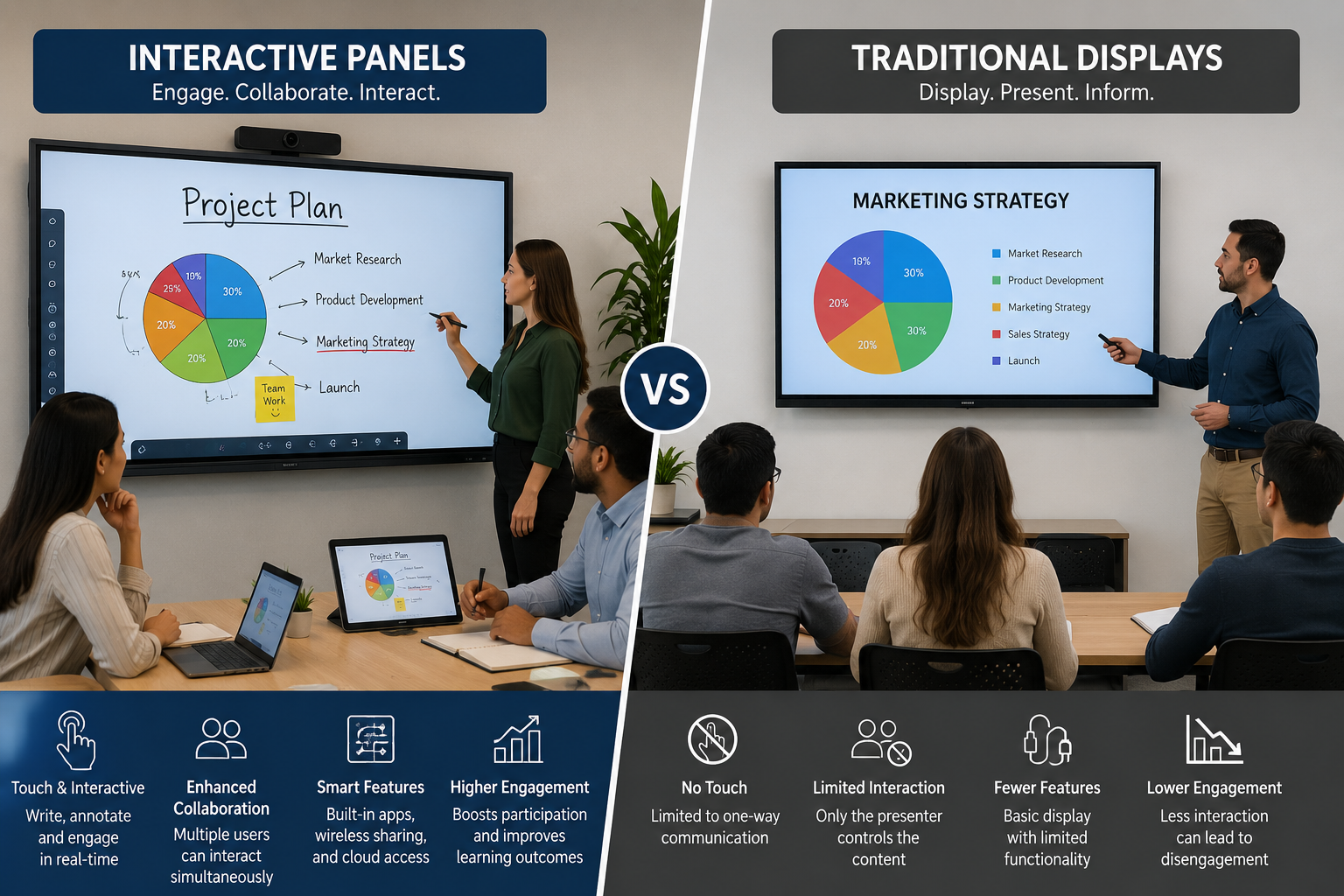
Interactive Panels vs Traditional Displays: Key Differences
Let’s break this down simply.
Traditional displays think projectors, TVs, whiteboards are largely one-directional. You present. Others watch.
Interactive panels flip that model. They invite input.
Key differences:
- Engagement
Traditional: passive
Interactive: participatory - Functionality
Traditional: limited tools
Interactive: touch, annotation, apps, connectivity - Ease of use
Traditional: often clunky (hello, projector cables)
Interactive: designed for immediacy - Flexibility
Traditional: fixed content
Interactive: adaptable in real time
In short, interactive panels are built for modern, collaborative environments. Traditional displays… not so much.
If you’re exploring options, it’s worth looking at professional-grade interactive whiteboards and panels that are designed specifically for education and business use.
Smart Board vs Traditional Whiteboard: Feature Comparison
This is one I’ve lived through.
There was a time when a whiteboard marker was the most powerful tool in the room. Simple. Reliable. No login required.
But then came smart boards.
Let’s compare:
Traditional whiteboard
- Low cost
- No tech failures
- Great for quick explanations
- Multi user (if you have enough pens with ink – always a problem in the classroom)
But…
- No saving of work
- No multimedia
- Limited engagement beyond writing/drawing
- Time intensive
- Quality of penmanship varied immensely
Interactive Display
- Save and share notes instantly
- Integrate video, images, and live content
- Enable collaboration at the board
- Preparation can be done out of the classroom
In a teaching context, this is a game-changer. You’re no longer rewriting the same diagram five times a day. You can build, save, and revisit. Students can contribute directly.
That shift alone moves learning from passive to active.
Digital Whiteboard vs Interactive Panel: Which Performs Better?
This is where things get interesting.
A digital whiteboard is typically software-based. Think apps running on laptops or tablets.
An interactive panel is a complete hardware solution that uses digital whiteboards as one of it’s tools, built for shared spaces.
So, who wins?
It depends on context.
Digital whiteboard strengths:
- Flexible
- Accessible from personal devices
- Great for remote collaboration
Interactive panel strengths:
- Larger, immersive experience
- Designed for groups
- No dependency on personal devices
In practice? Interactive panels often outperform in physical spaces, particularly in classrooms and meeting rooms where visibility, ease, and immediacy matter.
That said, the best setups often combine both a panel at the front and digital tools supported by individual devices.
Benefits of Interactive Panels for Collaboration and Learning
This is where I get a bit passionate.
Because I’ve seen the shift.
When technology works, people lean in.
Interactive panels offer:
- Real-time collaboration
Multiple users. Same screen. Same moment. - Visual learning support
Ideal for explaining complex ideas quickly - Seamless integration
Connect laptops, cloud platforms, and video calls - Improved retention
People remember what they do, not just what they see
In classrooms, this means:
- More student participation
- Better concept understanding
- Less repetition for teachers
In business, it means:
- Faster decision-making
- More productive meetings
- Clearer communication
Pair that with reliable audio equipment in Perth, and suddenly your space isn’t just functional, it’s high-performing.
Limitations of Traditional Displays in Modern Workspaces
Let’s be honest. Traditional setups are starting to show their age.
Common limitations:
- Setup time (and frustration)
- Limited interactivity
- Poor visibility in bright spaces
- No integration with modern tools
I’ve lost count of how many meetings started late because someone couldn’t get a projector working.
Or classrooms where half the time is spent rewriting notes instead of building on them.
These aren’t just minor inconveniences. They cost time, energy and engagement.
Factors to Consider When Choosing the Right Display Solution
There’s no one-size-fits-all answer. But there is a smarter way to choose.
Things to think about:
- Environment
Classroom? Boardroom? Open space? - User experience
Is it intuitive for everyone? - Integration
Will it work with your existing tech? - Scalability
Can it grow with your needs? - Support
Do you have access to reliable suppliers?
And one more often overlooked but essential to maximising the effective use of technology in the classroom and the boardroom:
- Training
Even the best tech fails if people don’t know how to use it properly
Cost and Maintenance Comparison of Interactive Panels vs Traditional Displays
Upfront cost tends to be the sticking point.
Yes, interactive panels typically require a higher initial investment than traditional displays. But they are no more difficult to install than a traditional display like a TV. Plus, Interactive displays usually have a much longer warranty than standard TVs, meaning less deinstallation/reinstallation costs and time without a display.
So you’re saving time. And time, especially in business and education, has real value.
When you factor in productivity gains, reduced downtime, and improved outcomes, the ROI often tips strongly in favour of interactive solutions.
Conclusion
Technology should make things easier. Clearer. More engaging.
That’s the real takeaway.
The debate around interactive panels vs traditional displays isn’t just about features, it’s about effectiveness. About outcomes. About how people interact with information.
From my experience in both teaching and professional environments, the difference is obvious. When you create spaces that invite participation, everything improves learning, collaboration, and results.
And while traditional tools still have their place, the future is firmly interactive.