

Mixer amplifiers are commonly installed in schools, community halls, churches, retail stores, cafés, gyms, office buildings, and any venue that needs simple control over microphones and background music. Their built-in mixing and amplification make them ideal for PA systems, paging, announcements, and multi-speaker setups.

If you’ve ever looked inside a school hall AV cabinet or peeked behind the counter at a community centre, you’ve probably seen a mysterious box with knobs, labels, and flashing LEDs. That box is often a mixer amplifier, one of the most essential yet misunderstood parts of commercial audio setups.
If you’ve ever wondered “what is a mixer amplifier?” or why it matters, this beginner’s guide breaks it down in simple, practical terms.
What Does a Mixer Amplifier Do?
A mixer amplifier is a device that combines two key functions:
- Mixing: controlling and balancing multiple audio inputs (microphones, music sources, announcement systems).
- Amplification: boosting that mixed audio so it can power speakers across a room, hall, or building.
The easiest way to think of it is as the “central brain” of a sound system. Instead of having one box to manage microphone levels and another to drive the speakers, a commercial mixer amplifier does both in one compact unit.
This is especially useful in places where you need simple, reliable operation without a full-blown mixing desk.
How Does a Mixer Amplifier Work?
At its core, a mixer amplifier takes multiple inputs, balances their volume and tone, and then sends an amplified signal to your speakers.
Here’s what’s happening inside the box:
- Input Section: Microphones, Bluetooth receivers, media players, and paging systems feed into separate channels.
- Mixing Stage: Each channel gets adjustable volume, EQ, and sometimes priority (e.g., announcements duck the music automatically).
- Power Amplification: Once the audio is mixed, the amplifier boosts it to a level suitable for driving speakers.
- Speaker Output: This may include low-impedance (8Ω/4Ω) outputs or 70V/100V line outputs for wide-area installations.
This simple but powerful combination is why mixer amplifiers show up in so many commercial and educational settings.
They tend to come in a variety of formats depending on their role, but generally, they are either rack-mounted units or desktop units.
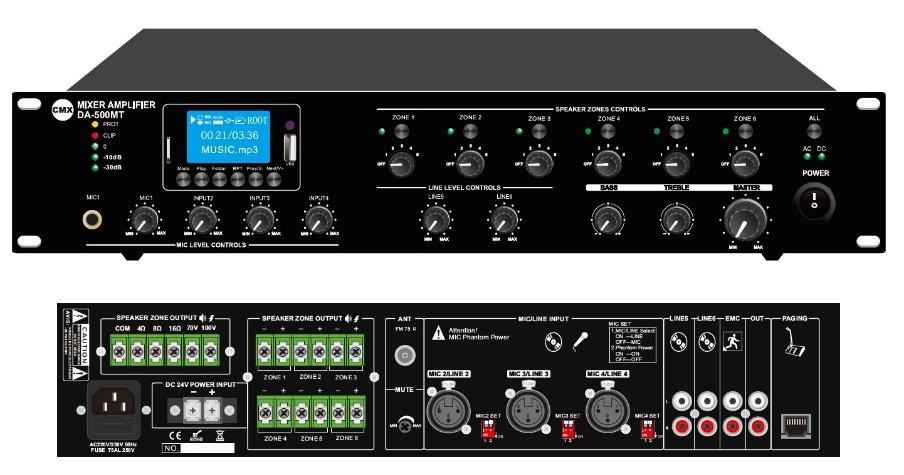
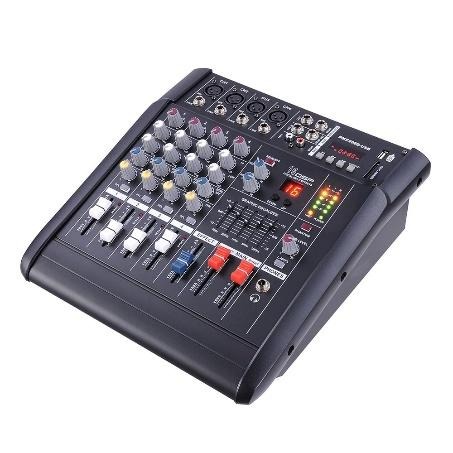
Mixer Amplifier vs Amplifier: What’s the Difference?
Many people confuse these two, but they’re not the same thing.
Amplifier Only
- Takes an audio signal
- Boosts it
- Sends it to speakers
- No mixing, no balancing, no microphone inputs
Mixer Amplifier
- Mixes multiple audio sources
- Adjusts volumes and EQ
- Then amplifies the audio
- All in one unit
So when someone asks “what is a mixer amplifier?” the key distinction is that it performs both jobs, making it ideal for small to medium installations where simplicity is crucial.
Where Are Mixer Amplifiers Used?
Because they’re reliable and easy to operate, you’ll find mixer amps in:
- School halls and classrooms
- Churches and community centres
- Retail shops and cafés
- Gyms and fitness studios
- Function rooms and boardrooms
- Buildings with paging or background music systems
They’re also extremely common in school PA system installation setups, where staff need a simple front-panel interface rather than a full AV control system.
Wherever you need microphones + music + public announcements in a single system, a mixer amplifier fits perfectly.
Types of Mixer Amplifiers
Mixer amplifiers come in several varieties, depending on the application and system size.
1. Basic Mixer Amplifiers
- Ideal for small rooms, cafés, and meeting spaces
- Few input channels
- Simple volume and tone controls
2. Commercial/100V Line Mixer Amplifiers
- Designed for large buildings and long cable runs
- Used for paging, school bells, and background music
- Perfect for ceiling speaker systems
3. Digital Mixer Amplifiers
- DSP (digital signal processing) is built in
- Presets for different room use cases
- Integration with networked audio systems
4. Rack-Mounted Professional Units
- Multiple zones (e.g., admin office, hall, library)
- Priority inputs for emergencies
- Compatible with paging consoles and building automation
The type you choose depends entirely on your space, your audio needs, and how many sources you need to manage.
Conclusion
Mixer amplifiers might look technical, but once you break them down, they’re actually one of the simplest (and most reliable) pieces of commercial audio gear. They mix your microphones, boost your sound, and keep your system running smoothly all in one compact unit.
If your school or organisation needs something easy to use, dependable, and built for daily announcements, microphones, and multimedia, a mixer amplifier is often the best place to start.
And if you’re planning new installations or upgrades, working with an experienced professional audiovisual installation team ensures the right system is matched to your space.